


It feels like it has gotten so common to ask an AI to fix your mistakes since it's easier than debugging. That's okay in most cases, but you need to go to the right AIs. I tested a few of them to see which gave a good output instead of just making a mistake or not helping at all. It turns out you should be very careful about what you get back. After this test, it's easy to see why vibe coding is pulling people in, but not teaching them.

ChatGPT's decline is real — I tested it against Claude on 3 routine tasks, and it lost every time
What happened, ChatGPT? We used to be cool.
You need to debug the root cause
If you don't learn, you'll never get better
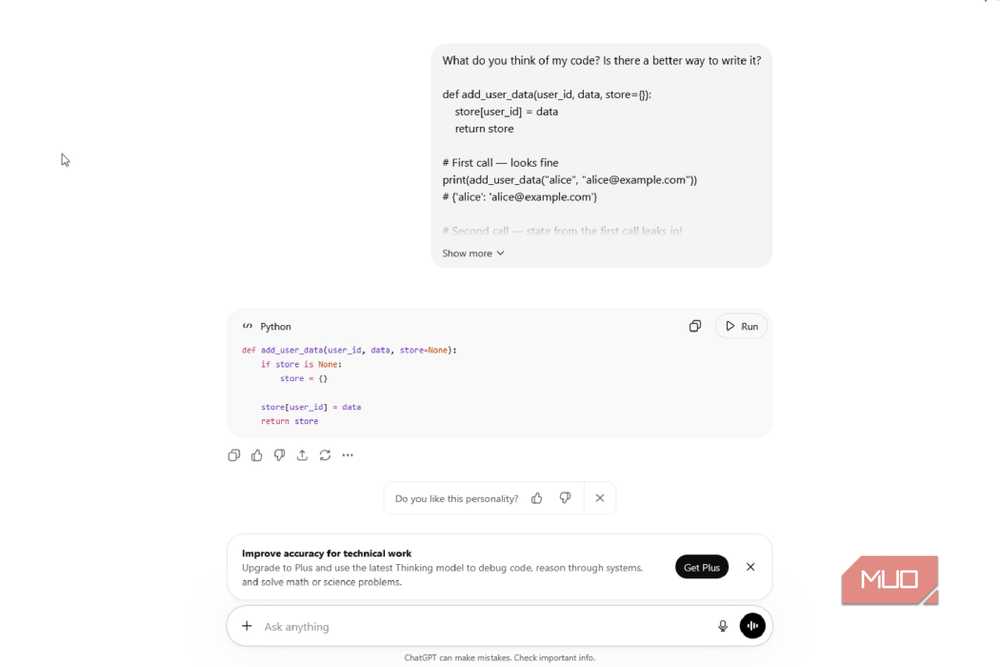
I tested Gemini, ChatGPT, and Claude on a tricky Python bug to see which one could actually explain what went wrong and not just hand back fixed code. The bug was a classic Python mistake. Basically, when you set a dictionary or list as a default function parameter, Python only creates it once when the function is first defined, not each time you call the function.
That means every call ends up sharing the same dictionary, and data from one user can bleed into another user's session without anyone realizing it. Any AI can rewrite broken code. The real question is whether it can teach you why the code was broken to begin with. Claude did this the best. Instead of just patching the code, it walked through the problem step by step and pointed to the line where things went wrong.
Gemini thought through the problem well, and GPT followed instructions reliably but did not give me what I needed. Claude explaining before fixing gave it a clear advantage.
Claude explained that Python stores default arguments on the function itself at the moment it's defined. The fix is to use None as the default and create a fresh object inside the function body. So Claude is giving me something I could actually use. You understood the fix, which means you could apply it elsewhere and spot the same mistake in the future.
Good debugging isn't just about making the error go away. It's how developers build a real understanding of how their systems work. An AI that explains its reasoning helps you stay in control of your own code, while one that just generates patches trains you to stop thinking.
Giving back bare code should always be considered a failure
If it can't explain why, it might as well be wrong

When I gave ChatGPT the buggy Python code, it did exactly what you'd hope an AI wouldn't do. It just handed back a fixed version with no explanation. On the surface, that looks like a win. The error is gone; the code runs, the problem solved. But that's actually the result you don't want.
When a developer receives fixed code with no context, they have no idea what was actually broken or why the fix works. They paste it in, move on, and the next time they write a function with a mutable default argument, they'll make the same mistake. Nothing was learned.
ChatGPT didn't just miss a teaching moment; it actively made the developer more dependent on asking the AI again next time.
This is the heart of vibe coding. All you're doing is putting in the code because the AI said so. You're not really processing what changed or what it means for the rest of the program. The danger is that you start trusting the output without questioning it. AI output is not always trustworthy, and you'll have trouble remembering what to keep an eye out for, just because you're so used to just trusting it.
In GPT's case, this played out in a concrete way. The fix it returned was correct. It compiled, it ran, and the obvious error disappeared. Since GPT fixed the issue, I gained nothing from the experience, and if this is something I wouldn't have been able to find myself, then that's even worse. I've learned nothing but to trust an AI, which is a bad lesson.
If it left an unseen bug in there, and I didn't know any better, I wouldn't even know how to test it. If you don't understand the original fix, you can't diagnose what's broken later.
Debugging isn't just about clearing error messages. It's the main way you can build a mental model of how your systems work. An AI that skips the explanation and goes straight to the fix doesn't save you time; it borrows time from your future self. This is because you will spend far longer untangling code you never understood in the first place.
Blindly pasting code could destroy what you have
The danger of blindly pasting code
AI-coding only sounds good at first. The idea is that you hit an error; you hand it to the AI, and you get the fixed code back in seconds. No documentation rabbit holes, no manually tracing where a variable went wrong. It feels like productivity, but there's a difference between moving fast and moving forward.
The problem isn't that the code is wrong; I've seen plenty of fixes come out perfectly from AI. The problem is that correct code you don't understand is a liability sitting in your codebase. It works until it doesn't, and when it breaks, you have no foundation to debug from. You just go back to the AI, paste the new error, and hope the next answer is better.
Each round of this makes your understanding of your own program shallower. This is where the real damage happens. AI models are good at recognizing patterns in code they've seen before. They're not good at understanding how your specific system behaves under load, how your database handles concurrent writes, or what happens when two users hit the same function at the same time.
So a fix that looks clean in isolation can quietly introduce a race condition, removing a lock it didn't realize was load-bearing. A good example is when these hidden defects inevitably cause an issue that grows. Developers who blindly paste code will eventually find themselves in a loop where the AI continues to break its own code.
I've seen this happen a lot before. The AI doesn't really understand what is wrong; it is just trying to give you an answer. So if it doesn't know, it starts changing things and will eventually forget too much, so it won't be able to get that old code back. It will get worse and worse until it's broken beyond repair.
In the end, that's your fault for trusting it so much.
Don't let the AI think for you
Letting an AI act like a teacher is harder than just getting a quick fix, but it is the only way to keep your codebase clean. If you rely on it to think for you, you won't gain the knowledge needed to spot the next bug before it hits production, but if you treat the process like a way to learn more, you'll get more than just the right answer.

Claude
- Developer
- Anthropic PBC
- Price model
- Free, subscription available
Claude is an advanced artificial intelligence assistant developed by Anthropic. Built on Constitutional AI principles, it excels at complex reasoning, sophisticated writing, and professional-grade coding assistance.