


AI slop is a real and present danger. As a writer and editor, I don't see myself using AI detection tools at every turn of the syllable. Instead, I am trying to train my eye to spot AI-generated content. It's still easy to spot deepfakes, but the written word is getting tougher to nail down.
Wikipedia offers some help. Its volunteer editors, the army who obsessively fight for knowledge, have quietly built the most evidence-based AI guide on the internet. Wikipedia's Signs of AI Writing page isn't an app or a checklist. It's just a simple page, meant primarily for Wikipedia's own articles written in wikitext. But even outside the encyclopedia, it might help you eyeball the next piece of AI writing you come across.

This AI App Will Help You Prove You Didn’t Use AI to Write Your Paper
This app will help prove that you didn't cheat.
Wikipedia built a handy AI detection field guide
No app needed — just pattern recognition

Wikipedia's Signs of AI Writing page started as an internal resource for volunteer editors. Since 2023, a group called WikiProject AI Cleanup has been reviewing new submissions for undisclosed AI-generated content. After combing through thousands of flagged articles, they cataloged the patterns they kept seeing in Wikipedia drafts and edits. The result is what Wikipedia says, that it's what the editors have observed, and it's more "signs" than "rules."
The page is worth a bookmark and a deep read. Instead of depending on AI writing detectors, it will help you spot-check writing behaviors. Those are the telltale giveaways of AI writing. As we all know, LLMs are just machines, and they are built on statistical probability, not on real storytelling skills.
When I first came across the page, I expected a basic checklist. What I found was closer to a 15,000-word field guide with categorized patterns, each with cited examples. I still can't remember all of it (printing a simple checklist is an idea). But I am using the main points to boost my skills at spotting AI chaff on the web. While a lot of the rules of this guide are applicable to Wikipedia, all of us can learn from editors who audit a mass of articles every day. Do remember that LLMs are updating every day. We will have to check back to see if the page keeps up with the pace of AI change.
AI loves to over-explain importance
Some words and sentences do too much work
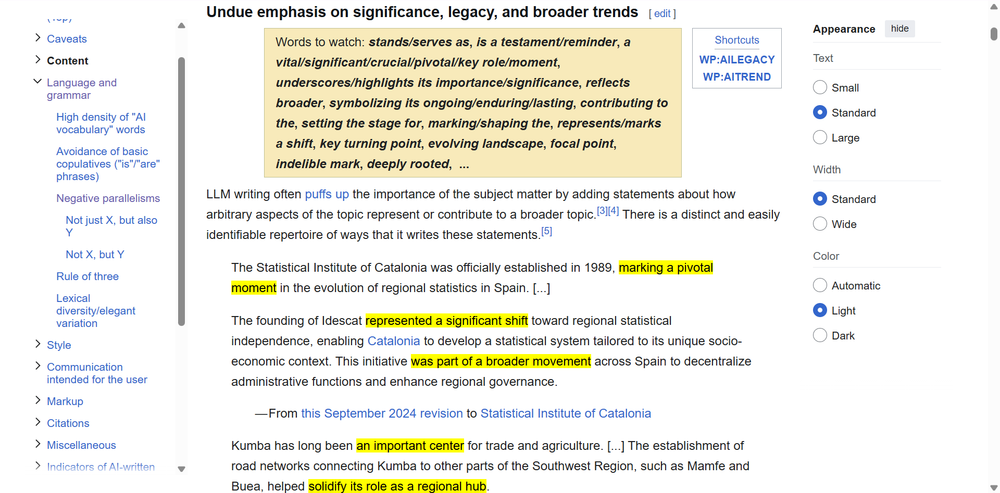
One of the guide's most useful observations is that AI writing inflates everything. It consistently describes ordinary facts as significant, transformative, or part of a "broader movement." The Wikipedia guide calls this puffing. You may have heard about puff pieces from journos. We read them every day in advertisements and AI-written product reviews. You can see the highlighted examples on the page and in the screenshot above.
AI models are trained to sound authoritative. As they hedge on patterns, they brush over verifiable facts. If you're reading something and every paragraph seems to be filled with airy adjectives, that's a real signal.
I've caught myself letting hyperbole slide in my own drafts. Now, I try to nix over-the-top adjectives and back claims with evidence. I guess it makes writing harder, but it lets each sentence stand on its own.
Formatting quirks are clues that pop up
Lists, em dashes, and boldfaces are tells
The guide dedicates a full section to formatting habits that AI prefers. These include excessive bullet points where a paragraph would work better, bolded terms on nearly every line, and the now-infamous em dash, which is usually deployed far less by good writers. AI also skips en dashes entirely, using hyphens for ranges like dates or scores where an en dash belongs.
These aren't random. AI models, after all, are trained on large volumes of online text, where heavy formatting is common. For instance, using both numbered and bulleted lists was part of almost all style guides not so long ago. I feel sad for the demise of the em-dash and lists, as they made prose far more readable in our attention-addled times. I will defend their choice to death.
Do note that a single formatting flag isn't proof of anything. It's when you see several of these habits stacking up while proofreading content that the pattern needs a closer look.
An interesting tidbit from Wikipedia's guide is that ChatGPT and DeepSeek typically use curly quotation marks rather than straight ones. Gemini and Claude models usually do not prefer curly quotes. I don't find this reliable, since other word processors have this quirk as well.
The vocabulary is surprisingly specific
These words are basically AI fingerprints
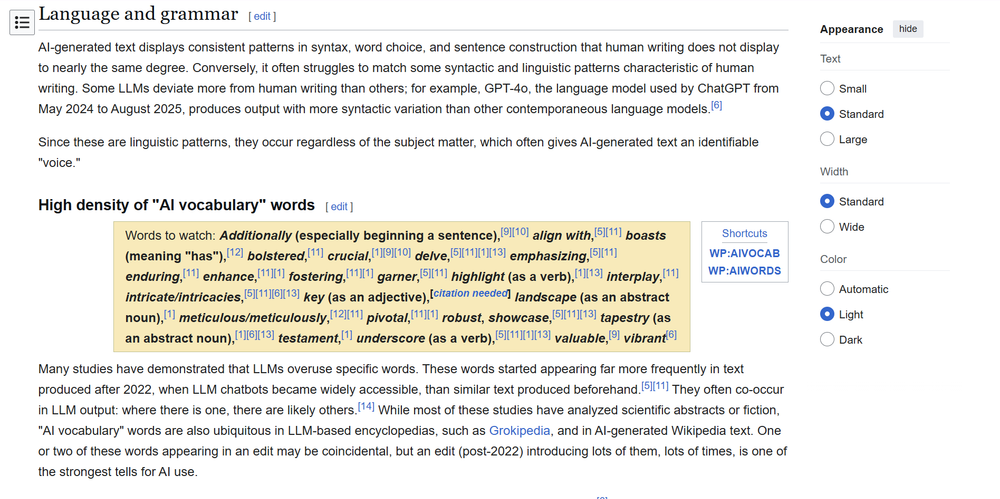
The guide flags a consistent set of words that AI models overuse. Examples are:
Delve, tapestry, pivotal, underscore, foster, testament, enhance, crucial, intricate, landscape.
These aren't wrong words. They're just statistically overrepresented because the models reach for them as safe choices. Wikipedia editors started calling them "AI vocabulary."
There's also a subtler pattern the guide calls "tailing clauses" — present participles tacked onto the end of sentences to add vague significance.
These phrases don't add anything extra, but they try to make sentences sound more important than they are. Once you know these words and constructions, you'll notice them almost instinctively. That's not a bad thing, as it makes you a sharper editor of any writing, including your own.
Automated detectors aren't reliable
Train your eye, and then audit your own drafts
The guide recommends not to rely on AI detection tools. A 2025 study cited in the guide found that even heavy LLM users correctly identified AI-generated text only about 90% of the time. That's one false identification for every ten judgments. Casual users did barely better than random chance. AI detectors like GPTZero are explicitly called out as weak on their own.
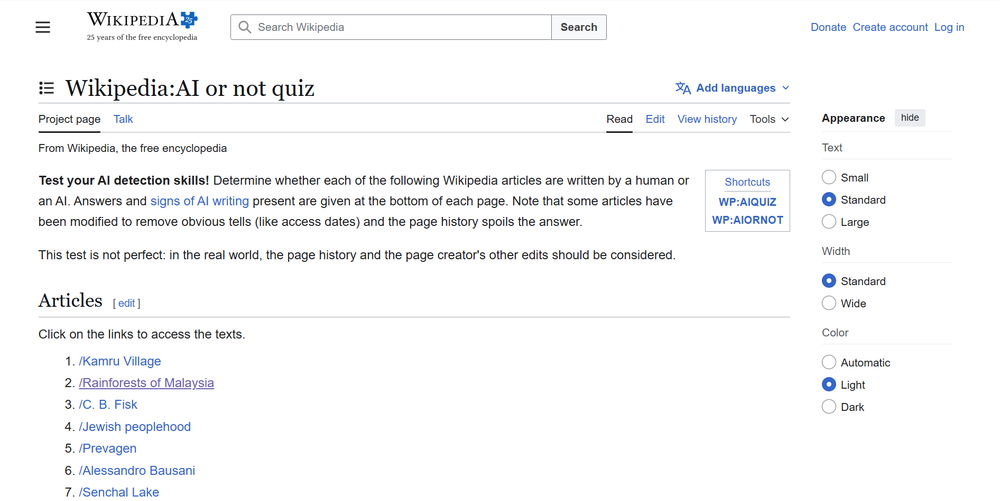
The more practical takeaway is to treat this guide as a self-audit checklist. I suggest picking up three characteristics at a time and practicing them on actual text. It can be your own, or you can play around with Wikipedia's AI or Not quiz.
One pass through Wikipedia's categories before you hit publish is more useful than any detector score. LLMs are getting better every day, and I wonder if it's a losing battle. The only win I can see is getting better at emotional and experiential storytelling. This is where AI chatbots are still behind us.

- OS
- Web, Android, iOS
- Price model
- Free
- Website
- https://en.wikipedia.org/
Wikipedia is a free, web-based encyclopedia written and maintained by volunteers from across the globe. It is operated by the Wikimedia Foundation and provides openly accessible information on a vast range of topics.
Learning to spot AI writing has consequences
We have normalized AI-assisted writing in business communication where speed matters. The cost of AI writing and plagiarism is greater in some cases, like academic work. These tips might help us deal with AI disinformation and improve critical thinking.
Open the Signs of AI Writing page alongside any article, homework, email, or post you suspect. It can be one of your own AI-assisted drafts. Test how many patterns you can catch (and correct).