


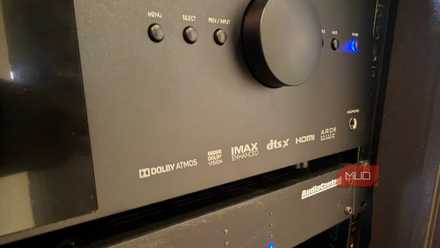
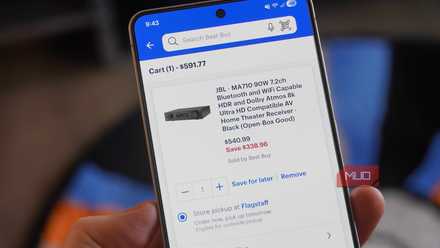
I switched from an audio-only stereo amplifier and receiver to an 8K Dolby Atmos A/V receiver, but I left a few features behind. My trusty Sony STR-DH190 receiver was designed for sound, and it offered a handful of ways to listen to my favorite tunes. I could use passive speakers, switch between A and B speaker sets, or plug headphones into the 1/4-inch jack. I lost this versatility when I upgraded to the JBL MA710, a home theater receiver designed to handle 7.1 or 5.1.2 surround sound setups.
My new receiver added Dolby Atmos support and numerous HDMI inputs, but lacked A/B front speaker and headphone jack support. Luckily, it offered something better — a set of pre-amplification RCA outputs labeled as "Zone 2." You can use these RCA outputs to hook up a pair of powered speakers or another amplifier, and the possibilities are almost endless. Now, I can stream music in my office while my partner watches a Dolby Atmos movie in our home theater, and one A/V receiver powers the entire thing.

I finally added Dolby Atmos to my home theater without drilling a single hole
I can't install surround sound speakers in my ceiling, but I found a better solution.
Zone 2 is different than A/B speakers
Many receivers offer A/B speaker support, but not Zone 2
There are many receivers that have enough binding posts or spring-clip terminals to connect two sets of passive speakers. These speaker sets are usually labeled as "A" and "B." Home theater receivers typically omit this feature, saving the extra binding posts or spring-clip terminals for additional surround or height speakers. Budget and audio-only receivers usually include A/B speaker terminals, which are both driven as basic left/right front speakers. You can choose which set of speakers you want to drive, or if your receiver is powerful enough, it can drive both A and B speaker sets at once.
I enjoyed having A/B speaker support and a headphone jack on the Sony STR-DH190 receiver I replaced, but the capability is inherently limited. The extra binding posts or spring-clip terminals are great for sending the same audio to pairs of front speakers in multiple rooms. However, receivers with A/B speaker terminals can't push different content to each set of speakers. So, if you want to listen to a streaming service in one room and a turntable in another, you're out of luck.
At first, I thought the expensive JBL MA710 receiver I upgraded to wasn't capable of multi-room playback. That's because I almost missed the Zone 2 output hidden between the phono input, analog inputs, and subwoofer outputs. If your receiver has RCA outputs for Zone 2, you can enjoy a multi-room listening experience — but there's a catch. As these are pre-amplification RCA outputs, you'll need to either use powered speakers in Zone 2 or buy another amplifier to handle your second room.
The biggest Dolby Atmos upgrade isn’t a new sound system — it's this
Blu-ray discs are the key to getting Dolby Atmos music and moves in lossless audio quality, and almost no one realizes it.
Your receiver can drive two separate systems
Watch a movie in your Dolby Atmos theater while streaming Spotify somewhere else

Zone 2 outputs have limitations of their own. For one, not every receiver supports independent playback for speakers in the "Main Zone" and speakers in Zone 2. There are some A/V receivers that only mirror the audio playing in the Main Zone through the Zone 2 speakers. There may be workarounds to help you skirt these limitations. For example, I've mapped a video input to an analog audio input so I can listen to my turntable while playing console games on the TV.
If you have a high-end A/V receiver capable of driving the Main Zone and Zone 2 speakers separately, things get exciting. You can watch a movie in surround sound in the Main Zone while listening to a CD player in Zone 2, with one receiver driving everything. It creates a multi-room audio experience without forcing you to buy extra hardware or use a complicated setup. I repurposed an older set of powered Edifier speakers as my Zone 2 outputs, and now I listen to music in my office amplified from the receiver and turntable in my living room.
Compared to using A/B speaker sets on my older receiver, Zone 2 is a major upgrade. The granular control over each speaker is more versatile than a simple mirror, and the ability to hook up an extra receiver to the Zone 2 outputs offers additional flexibility. I have a desktop DAC and amplifier in my office, so I ran the Zone 2 output cables into my secondary amplifier. So, I can listen to Zone 2 content from my living room A/V receiver in my office with high-impedance, balanced output headphones — and it's incredible.
I saved hundreds on a Dolby Atmos system using this simple strategy most people miss
Some audiophiles swear by buying new gear, others live or die on the resale market. There's a better way, and it's the perfect middle ground.
Zone 2 makes my receiver investment worth it
Dolby Atmos receivers are expensive, but one can power my entire home
I was excited to have finally completed my Dolby Atmos home theater, but before finding Zone 2 on my receiver, I couldn't help but feel like I lost features from the listening station I replaced. As it turns out, Zone 2 is an upgrade compared to basic A/B terminals for passive speakers. With the right gear, you can play separate content in multiple rooms, or mirror the same audio across your entire home. It's easy to ignore all the RCA inputs and outputs on the back of your receiver, but Zone 2 is worth your attention.

JBL MA710 AV Home Theater Receiver
- Type
- 7.2 Dolby Atmos, DTS:X
- Bluetooth
- Bluetooth 5.3, Low Energy
- Wi-Fi
- Wi-Fi 5
- Amplifier
- 110W x 2ch @ 8ohms, 90W x 7ch @ 8ohms
- Connectivity
- 3 x HDMI 2.1, 3 x HDMI 2.0, 1x LAN
JBL's MA710 is an AV receiver designed for home theater use with support for Dolby Atmos, DTS:X, and a maximum 8K video resolution. It includes six HDMI inputs and one HDMI output, plus five audio-only inputs. Whether you're looking to build a Dolby Atmos audiophile listening station or a 7.2 surround sound home theater setup, this receiver can handle it all.