

Introduction to the Deep Reefs
On a bright, sunny day last May, I stood on a boat surrounded by the turquoise waters of the island nation of Palau. I was there to witness scuba divers preparing to bring up evidence of a mysterious aquatic world. Palau is famous for its spectacular and rich coral reefs, but these divers were planning to descend past those sun-lit marine communities and down into a lesser-known twilight zone known as the “mesophotic coral ecosystem.
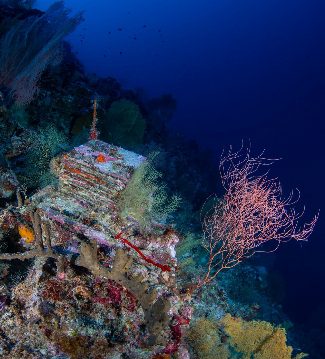
The Mesophotic Coral Ecosystem
Mesophotic essentially means “middle” and “light,” referring to ecosystems that are neither in the bright daylight nor in the profound darkness, but somewhere in between. For simplicity’s sake, we’ll call these communities, which range from some 30 meters to 150 meters below the surface, the “deep reefs.
One of the divers on the boat with me was a zoologist and curator at the California Academy of Sciences named Luiz Rocha, who has spent decades studying these deep reefs and their secrets. Rocha is part of a team that has been conducting a decade-long experiment to unlock the mysteries of these unknown ecosystems. They left some scientific structures down in these twilight depths back in 2016 and have now returned to retrieve them, hoping to learn more about the main energy source, the food chain, and the evolution of life at these depths.
Researchers like Rocha are using innovative techniques to study the deep reefs. One such technique is the use of "autonomous reef monitoring structures" or ARMS. Each ARMS is a stack of several PVC plates, separated at uniform intervals and attached to a base plate. They look like little gray, featureless hotels. Rocha and his colleagues have been deploying ARMS in the deep reefs around Palau, Guam, the Marshall Islands, and French Polynesia to gather data on the biodiversity of these ecosystems.
Scientists can dive into the deep reefs to try to learn more about these understudied places, but exploring down at 100 meters requires more difficult, riskier technical diving than exploring at shallower depths. The deeper you dive, the faster gases get pushed into your tissues, which imposes limits on these really deep dives.
The Future of Deep Reef Research
Rocha is not deterred by the enormous number of questions surrounding these deep reefs. He has been gathering bits of basic information about them, often via those very short dives. He has also used remote-operated vehicles and submersibles to explore the deep reefs, but these have their own issues, and cameras can’t always capture all the detail you might want, or photograph more secretive, cryptic animals. So huge gaps remain in scientific knowledge about these ecosystems.
Conclusion
In some ways, we don’t even know what questions to ask. We really only know what the crucial questions are when we have a baseline understanding of the ecosystem. However, with the use of innovative techniques like ARMS, scientists are making significant progress in unlocking the mysteries of the ocean’s deep reefs and understanding their role in marine ecosystems.
Comments