

Introduction
China's Tianwen-2 probe, part of the China National Space Administration's asteroid exploration program, has achieved a remarkable feat by rendezvousing with the asteroid Kamo'olewa. This mission, which began in June 2026, has been a testament to China's growing prowess in deep space exploration. After a 400-day journey covering approximately 1 billion kilometers, Tianwen-2 successfully reached Kamo'olewa, the most stable quasi-satellite of Earth, orbiting the sun in near-synchronous motion with our planet.
Initial Detection and First Images
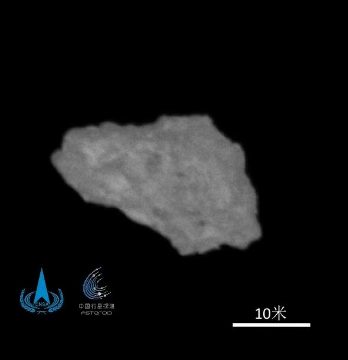
The probe first detected Kamo'olewa on June 6, 2026, and on July 2, it captured the first-ever images of the asteroid from a distance of about 20 kilometers. This achievement underscores the mission's success and the probe's advanced capabilities. The images provided valuable insights into the asteroid's shape, composition, and internal structure.
Challenges Ahead
While the initial images and detections were a significant milestone, the real challenge lies ahead. Landing on Kamo'olewa and gathering samples will be a formidable task. The asteroid's diameter is only about 41 meters, and it rotates at a high speed, making it difficult for the spacecraft to achieve stable contact and collect samples within a limited time frame. If successful, Tianwen-2 will release the samples it gathers during an Earth flyby in November 2027.
Scientific Objectives
The Tianwen-2 mission is not only about capturing images and gathering samples but also conducting detailed scientific observations. The probe is equipped with multiple cameras, including a detachable camera designed for sample collection. The mission aims to understand the asteroid's shape, material composition, and internal structure, which could provide crucial insights into the early formation of the solar system.
Controversy and New Insights
The mission has also sparked new scientific debate. Researchers previously theorized that Kamo'olewa was a fragment of the moon blown away by an asteroid impact millions of years ago. However, a recent reanalysis of available data and an experiment conducted by an international research team have cast doubt on this hypothesis. The new findings suggest that Kamo'olewa might be a fragment of the LL chondrite meteorite, likely originating from the Flora family in the asteroid belt.
Conclusion
If Tianwen-2 is successful in its mission to take samples and return to Earth, it will mark another significant achievement in asteroid sample return, following Japan's Hayabusa and Hayabusa2 missions and NASA's OSIRIS-REx mission. The mission's success will not only advance our understanding of Kamo'olewa but also provide valuable insights into the early formation of the solar system. The Tianwen-2 mission is a testament to China's growing capabilities in deep space exploration and a significant step forward in our quest to understand the universe.
Comments