
Understanding the physics behind Tesla’s Flying Roadster is fascinating. The car’s ability to defy gravity and drive up walls is made possible by a combination of static friction and air pressure. Let’s break down the key principles and how they work together to make this incredible vehicle possible.
How Static Friction Works
The first principle we need to understand is static friction. This is the force that prevents objects from sliding when they are in contact with each other. In the case of the Roadster 2, static friction plays a crucial role in allowing the car to stay glued to a vertical wall. The static friction force (Ff) is given by the equation Ff = μFN, where μ is the coefficient of static friction and FN is the normal force. For rubber on asphalt, the coefficient of static friction is around 0.6. The normal force is the force perpendicular to the surface, and it is influenced by the weight of the car and the angle of the incline.
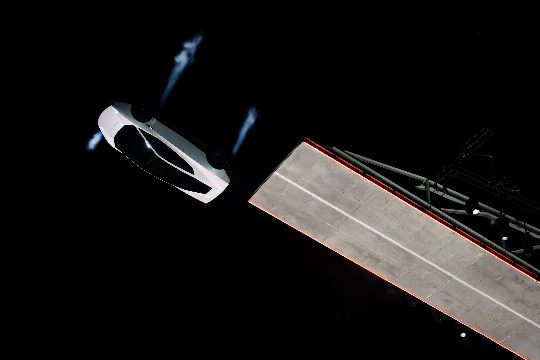
For a car to drive up a vertical wall, the static friction force must be equal to the gravitational force acting on the car. This means the car needs to create a significant normal force. The Roadster 2 achieves this by using fans to blow air out from under the car, reducing the air pressure under the car and creating a pressure difference that allows it to stick to the wall.
The Role of Air Pressure
The second key principle is the use of air pressure to create the necessary normal force. The Roadster 2 uses fans to blow air out from under the car, creating a lower pressure under the car. This pressure difference is what allows the car to adhere to the wall. The fans are strategically placed to ensure the car stays in contact with the wall and can maintain its position.
Practical Tips for Understanding Static Friction and Air Pressure
Understanding these principles can help you appreciate the engineering behind Tesla’s Flying Roadster. Here are a few practical tips to apply these concepts in real-world scenarios:
- Increase Static Friction: To increase the static friction force, you can use materials with higher coefficients of friction. For example, using rubber tires instead of metal wheels can increase the friction force.
- Create Pressure Differences: To create a pressure difference, you can use fans or other devices to blow air or water in a controlled manner. This can be useful in various applications, such as creating a suction cup or improving the grip of a climbing wall.
By understanding these principles, you can apply them to various scenarios, from improving the performance of vehicles to creating innovative solutions in different fields.
--
In conclusion, Tesla’s Flying Roadster is a testament to the power of physics. By leveraging static friction and air pressure, the car can defy gravity and perform incredible feats. Understanding these principles can help you appreciate the engineering behind such vehicles and inspire you to innovate in your own projects.
--