

Introduction
The discovery of a giant fungus in China's Yunnan Province has shed light on the vast biodiversity of fungi in East Asian forests. Named Dianjunus rex, this Ascomycete fungus is the largest recorded in terms of mass and size. This article provides a comprehensive overview of the discovery, including its classification, habitat, and potential ecological significance.
Classification and Habitat
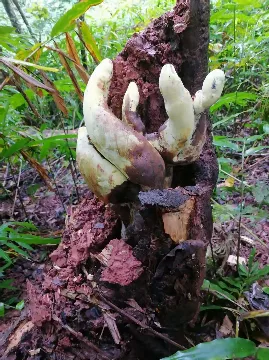
Dianjunus rex belongs to the Ascomycete phylum, which is the largest phylum of fungi with over 64,000 known species. The new species was discovered in the Nanban tropical rainforest, where the researchers found large, whitish fruiting bodies growing in the soil near the roots of dying trees. These fruiting bodies are characterized by finger-like branches and appear to develop from underground portions that are black and smooth. The above-ground portions are covered with white, powdery fibers that turn dark yellow as the fungi mature.
Genetic Analysis
Genomic analyses of Dianjunus rex revealed that it diverged from other species approximately 65 million years ago, during the end of the Cretaceous period. The researchers also found that Dianjunus rex has only about half the usual number of decomposition-related genes compared to its closest relatives, which also feast on plant matter. This suggests that Dianjunus rex may be leading a "," ":
"double life,", "living inside healthy trees and then feeding on dead plant material when the hosts die. This could explain how Dianjunus rex is able to store enough energy to build the massive fruiting bodies.
Ecological Significance
The discovery of Dianjunus rex underscores the importance of continued exploration of fungal biodiversity in East Asian forests. The researchers hypothesize that the benefit of these large fruiting bodies is that they tower higher than the surrounding plants and fallen leaves, which could be advantageous for wind-mediated spore dispersal in a dense forest. However, the large structure requires substantial energy investment, suggesting that this strategy likely evolved only where the ecological benefits outweighed the costs.
Comments