

Introduction
The August 2023 total solar eclipse was a spectacle unlike any seen in over a century, with Spain being one of the few countries in Europe to experience the phenomenon. The event, visible in parts of North America, Europe, and Africa, provided a unique opportunity for capturing breathtaking images and conducting scientific research. This guide explores the highlights of the eclipse, from its occurrence to the images that have captured the world's attention.
The Eclipse Event
The total solar eclipse occurred on August 19, 2023, with the path of totality traversing the northern hemisphere from west to east. The event began in the Arctic Ocean, north of Greenland continued over Iceland, the North Atlantic, and eventually reached the Iberian Peninsula, including Spain, where the shadow of the moon reached the country at 8:30 PM Central European Summer Time.
Observing the Eclipse
Observatories and parks across Spain hosted events to observe the eclipse. In Madrid, El Cerro del Tío Pío Park became a focal point, with people gathering to witness the total solar eclipse. Other regions such as Galicia, Asturias, Castile and León, Madrid, Aragon, Catalonia, the Valencian Community, and the Balearic Islands also experienced the path of totality. The eclipse lasted about four and a half hours, with the total darkening of the sky lasting just under two minutes.
The Beauty of the Eclipse
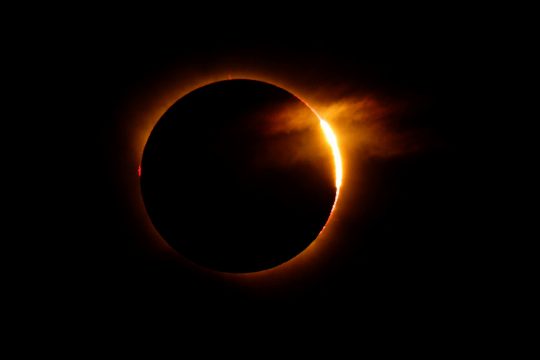
The solar corona, the outermost layer of the sun, glowed as the moon completely obscured the sun during the totality phase. Stunning images of the eclipse were captured from various locations, including Arenal Beach in Llucmajor, Mallorca, and the coastal lagoon of La Albufera in Valencia. The eclipse provided a unique opportunity for capturing the beauty of this natural phenomenon, with many people using special glasses to observe the event.
Scientific Research
The event was not only a visual feast but also a scientific opportunity. NASA's WB-57 high-altitude research aircraft flew at 50,000 feet to track the moon's shadow, while teams of scientists launched scientific balloons before, during, and after the event. The goal was to gather data on the dynamics of the solar corona, which can only be studied in detail during total eclipses. The event also brought students from various universities in the US to Spain and Iceland to conduct scientific experiments.
The Aftermath
The total solar eclipse was followed by a partial lunar eclipse in the Americas. While the event itself was a moment of wonder, the images captured during the eclipse have captured the world's attention and continue to inspire awe and scientific inquiry.
Conclusion
The 2023 total solar eclipse in Spain was a moment of wonder and scientific opportunity. The images captured during the event have not only captured the beauty of the natural phenomenon but also provided valuable insights for scientists and researchers. As we look forward to future astronomical events, the images of the 2023 total solar eclipse in Spain will serve as a reminder of the power of nature and the importance of scientific exploration.
Comments