

Understanding 8K Resolution and Human Vision Acuity
The term 8K, representing 7,680 by 4,320 pixels, is often highlighted as a significant upgrade over 4K, which has 4,096 by 2,160 pixels. However, the effectiveness of 8K is heavily influenced by human visual acuity. At typical viewing distances, the human eye cannot reliably perceive the additional detail provided by 8K. Standard visual acuity calculations suggest that viewers need a display around 100 to 150 inches to reliably see the difference between 4K and 8K. This is impractical for most living room setups, where viewers typically sit at distances of 8 to 12 feet from a 65- to 85-inch TV.
The Limitations of 8K in Real-World Viewing
A double-blind study conducted by Warner Bros. and others found that increasing resolution from 4K to 8K under typical viewing conditions did not result in a statistically significant improvement in perceived image quality for viewers with normal vision seated at typical distances. While participants with sharper-than-normal vision in the front row might perceive slight improvements, the majority of viewers do not notice a difference. This underscores the fact that the resolution jump from 4K to 8K is often not perceptible in real-world settings.
The Current State of Content Delivery
Despite the potential of 8K, the current state of content delivery does not support its widespread adoption. No major streaming service currently offers native 8K content, and broadcast television and gaming do not yet support 8K. Most console gaming targets 4K at 60 frames per second, with 8K rendering being limited to high-end models like the PS5 Pro. This means that the majority of content viewers will be watching up-scaled 4K or lower-resolution content on their 8K TVs, which can lead to a diminished perceived quality.
The Role of Upscaling in 8K TVs
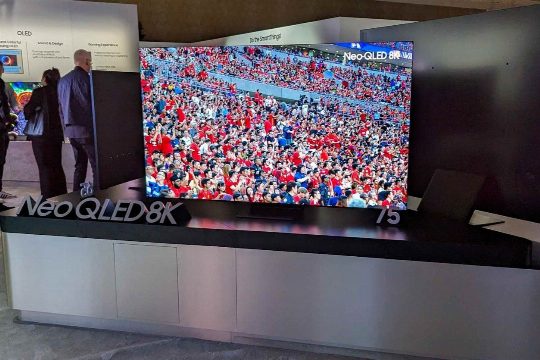
While the resolution itself may not be perceptible, the role of upscaling in 8K TVs cannot be overlooked. Samsung's flagship Neo QLED models use AI-assisted processing to analyze and enhance lower-resolution signals before they reach the panel. When this works well, the result can look cleaner and more detailed than a native 4K signal on a weaker TV. However, upscaling is not a resolution upgrade, and its effectiveness depends on the quality of the input signal and the quality of the upscaling algorithms used.
Conclusion
In summary, the number 8K is often the most persuasive selling point for TVs, but its impact is limited by human visual acuity and the current state of content delivery. While upscaling can improve the quality of lower-resolution content, the resolution itself may not be perceptible in real-world settings. As the industry continues to evolve, it is important to consider the limitations of 8K and the potential of upscaling technologies to enhance the viewing experience.
Comments