

Introduction
When Soundgarden wrote the song 'Black Hole Sun,' they may have been onto something. In a new study published in Nature, scientists have identified a hypothetical black hole star, a cosmic enigma that is the size of our solar system and emits bright red light in deep space. The James Webb Space Telescope (JWST) has played a pivotal role in this discovery, revealing the object’s characteristics and behavior. This article delves into the findings and implications of the black hole star hypothesis.
The Hypothetical Black Hole Star
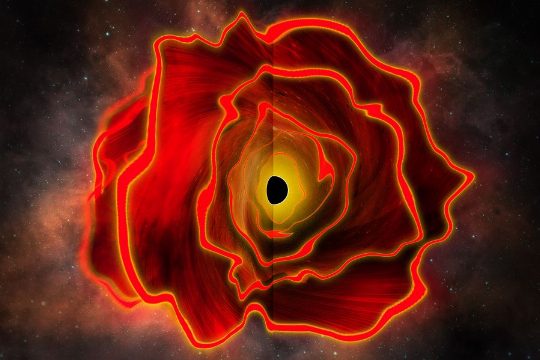
The black hole star, known as MoM-BH*-1, was observed by the JWST in the early universe, approximately 660 million years after the Big Bang. Despite its size, it emits about 100 billion times more energy than any star could produce through nuclear fusion. This anomaly has led researchers to propose that the object is a black hole shrouded in an extraordinarily dense and luminous gas.
Characteristics and Behavior
The black hole star exhibits several curious properties. It appears to be a giant star, but its luminosity and energy output are far beyond what can be explained by traditional stellar phenomena. The object’s light is abruptly disappearing, a phenomenon that cannot be attributed to normal star behavior. Researchers hypothesize that the light’s disappearance is due to an immense amount of extremely dense gas absorbing that light.
Implications and Hypothesis
The black hole star hypothesis could help address another mystery uncovered by the JWST. The telescope frequently detects small red spots in the early universe, whose origins remain uncertain. These spots could be compact galaxies, black holes hidden by dust, or systems entirely different from those observed in the present-day universe. The black hole star, including MoM-BH*-1, is one of these possibilities.
Special Case: MoM-BH*-1
MoM-BH-1 stands out among other red spots because the black hole appears to almost completely obscure its surrounding galaxy. This unique characteristic makes it a compelling subject for further study. The lead author of the study, Rohan Naidu, notes that every red spot observed by the JWST is consistent with being a black hole star, but MoM-BH-1 is particularly noteworthy for its extreme luminosity and its ability to outshine its host galaxy.
Conclusion
The discovery of the black hole star represents a significant step forward in our understanding of the cosmos. It challenges our conventional notions of stellar behavior and raises intriguing questions about the nature of black holes and their interaction with surrounding matter. As research continues, the black hole star hypothesis may provide valuable insights into the early universe and the mysteries that still remain to be unraveled.
Comments